Computational Statistics

Introduction
Computational Statistics (pex523) is a graduate course in the Graduate Program in Statistics and Agricultural Experimentation at the Federal University of Lavras (UFLA). I started teaching this course when Professor Eduardo Bearzoti decided to reshape his professional career. As I was beginning to write my book, Computational Statistics in Pascal—and later decided to use Java instead of Pascal—I decided to take on the course. Initially, I co-taught the course with Professor Ruben Delly Veiga—who was my professor, later my advisee, and to this day a good friend—who taught a section using SAS. He introduced IML for simulations along with various other features of the powerful SAS system.
Upon taking full responsibility for the course, I decided to teach it in a programming language more accessible to students. Therefore, I chose R and prepared lecture notes based on the manuscript of the book I was writing. I converted the code from Pascal to R and taught the course for the first time using R, which I continue to do to this day.
Published Book
I published the book Computational Statistics in Java through Editora UFLA in 2013. In this book, I developed and described several classes and packages for basic computational statistics, such as random number generation, computing probability densities, quantiles, and cumulative distribution functions for various probability distributions, among many other topics. I also addressed non-central distributions and multiple comparison procedures. Furthermore, I covered computationally intensive methods such as bootstrap, jackknife, Monte Carlo, and permutation tests.
The book is available at Editora UFLA or on Amazon.
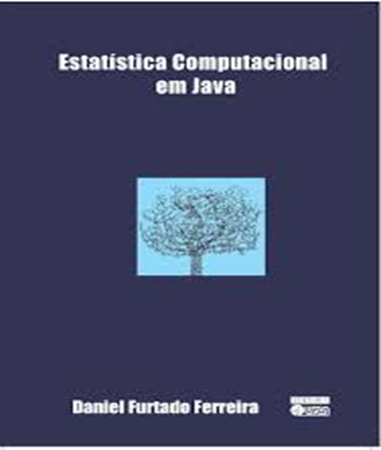
The book cover is shown below:
- Book Table of Contents: download
- Visit the book page at the Publisher.
Lecture Notes
The lecture notes I use in the course are based on the manuscript that gave rise to the 2013 book Computational Statistics in Java. However, the code in these lecture notes was prepared in R. The goal is to present core concepts of computationally intensive procedures, ranging from uniform random number generation to numerical quadrature for obtaining the PDF and CDF of various probability distributions. At each step, students are introduced to key theoretical results, a simple supervised and discussed implementation, exercises to complete, and finally, optimized R code corresponding to the concepts presented and discussed interactively during class.
- Course pex523 lecture notes in PDF: download