Basic Statistics
Chapter 6 Continuous Probability Distributions
6.1 Exercises
-
6.1.1 Suppose that the melting point of a certain substance is uniformly distributed in the interval \([100\), \(125]\), due to the variable presence of impurities. What is the probability that the substance melts between \(108\) and \(122\)? What is the probability that the melting point is greater than \(115\)?
-
6.1.2 The efficiency of a certain electronic component varies uniformly between \(0\) and \(100\). Knowing that the average production cost for each component is \(C\), but that the selling price of each one depends on its efficiency as follows: if the efficiency is less than \(20\), the component is sold for \(P_1\) monetary units (m.u.); if the efficiency is between \(20\) and \(50\), the component is sold for \(P_2\) m.u.; if the efficiency is between \(50\) and \(80\), the component is sold for \(P_3\) m.u.; and if the efficiency is greater than \(80\), the component is sold for \(P_4\) m.u.
-
a) What is the expected average profit per component?
-
b) The following relations of selling price and cost are known: \(P_1\) \(=\) \(0\); \(P_2\) \(=\) \(P_3/2\) \(=\) \(P_4/4\); and \(C\) \(=\) \(10\). What should be the values of the unknown prices (\(P_2\), \(P_3\), and \(P_4\)) so that the expected average profit/component is equal to \(2\) m.u.? What should be the minimum value of these prices so that there are no losses?
-
-
6.1.3 The exponential distribution fitted to data on the daily rainfall totals for the month of January in Pelotas, RS, resulted in the probability density function \(f(x)\) \(=\) 0.0696\(e^{-0.0696x}\), where \(X\) represents the daily rainfall total in mm. It is asked:
-
a) What is the mean daily rainfall total?
-
b) What is the probability of raining more than \(25\) mm on any given day in January in the region?
-
c) What is the probability that the total daily rainfall is less than \(5\) mm?
-
d) What is the probability that the total daily rainfall is between \(10\) and \(18\) mm?
-
-
6.1.4 Present two method-of-moments estimators for the parameter \(\lambda \) of the exponential distribution. These estimators are obtained by equating the moments of the distribution (mean, variance, etc.) to the usual sample estimators of these moments.
-
6.1.5 Another type of estimator is known as the maximum likelihood estimator. This estimator is obtained through a series of procedures briefly described below:
-
i) A random sample of size \(n\) is taken from the reference probability distribution (infinite population) with \(x_i\) independent of \(x_{i'}\), for all \(i\ne i'\);
-
ii) The likelihood function (\(L\)) is constructed, given by the product of the densities for all \(i\)
\(\seteqnumber{0}{6.}{0}\)\begin{align*} L=& \prod _{i=1}^n f(x_i); \end{align*}
-
iii) The natural logarithm of \(L\), \(lnL\), is taken and the resulting expression is differentiated with respect to the parameters contained in the density (\(\theta _i\)’s). The partial derivatives are set equal to zero and the resulting equation or system of equations is solved for the parameters. The results obtained are the maximum likelihood estimators.
-
a) Obtain the maximum likelihood estimator of the parameter \(\lambda \) of the exponential distribution. Consider that the \(n\) elements of the sample are known.
-
b) Compare the results with the method-of-moments estimators obtained in the previous exercise.
-
-
6.1.6 Obtain the following probabilities for the standard normal distribution, \(N(0\), \(1)\).
\(\seteqnumber{0}{6.}{0}\)\begin{align*} a)&\, P(Z>1.5) &&& b)&\, P(Z>-1.5) &&& c)& \,P(-1.5<Z<1.5)\\ d)&\, P(-1.96 < Z < 1.96) &&& e)&\, P(Z>0) &&& f)&\,P(1.30<Z<1.9) \end{align*}
-
6.1.7 Find the values \(z\) of the \(N(0\), \(1)\) distribution such that:
\(\seteqnumber{0}{6.}{0}\)\begin{align*} a)&\, P(Z>z)=0.975 &&& b)&\, P(Z>z)=0.025\\ c)& \,P(Z<z)=0.975 &&& d)&\, P(1<Z< z)=0.10\\ e)&\, P(-1<Z<z)=0.20 &&& f)&\, P(-1<Z<z)=0.40 \end{align*}
-
6.1.8 A hybrid rabbit breed, Norfolk, has slaughter weight at \(90\) days \(X\) with distribution \(N(\)2.60, 0.04\()\). Obtain the probabilities and the weight values \(x\), \(\mu -x\) or \(\mu +x\), according to the following probabilistic statements:
\(\seteqnumber{0}{6.}{0}\)\begin{align*} a)&\, P(X > 2.70) &&& b)&\, P(X < 2.45)\\ c)& \,P(2.55<X <2.65) &&& d)&\, P(X > x) = 0.80\\ e)&\, P(\mu -x<X<\mu +x) = 0.95 &&& f)&\, P(\mu -x<X<\mu +x)=0.90 \end{align*} PS. There is an error in the statement of items (e) and (f) in the Book. The correct statement is the one presented here. For example, as it is in the Book, the value of \(X\) is \(x=\)2.93 kg. It will be corrected in the next printing and/or edition.
-
g) A division was made by the buyers classifying the rabbits into weight classes as follows: E: the lightest \(15\%\); D: the next \(20\%\) after category E; C: the next \(25\%\) after category D; B: the next \(30\%\) after category C; A: the heaviest \(10\%\). The scheme is presented below.
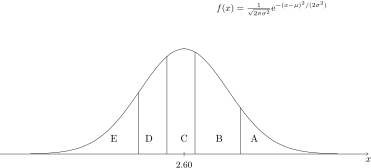
-
i) Determine the weight limits of each category.
-
ii) If the values in m.u. paid to each category are: E: 2.1 m.u./rabbit; D: 3.0 m.u./rabbit; C: 5.0 m.u./rabbit; B: 5.2 m.u./rabbit; A: 2.5 m.u./rabbit. Determine the average revenue per rabbit. If the average cost of each rabbit is 2.6 m.u., what is the expected average profit per rabbit?
-
-
6.1.9 Suppose that the number of seeds that germinate \((Y)\) of a species follows a binomial distribution. Knowing that the probability of a seed germinating is \(70\%\), it is asked:
-
a) What is the probability, in an experiment with a pot with \(n = 5\) seeds, of at least \(4\) germinating?
-
b) It is known that \(X\) represents the number of pots that have at least \(4\) germinated seeds of this species (originated from item a), so what is the number (sample size) of pots, to be sown with exactly \(5\) seeds, necessary so that there is a \(95\%\) probability that an experiment will be carried out with a quantity not less than \(30\) pots?
-
-
6.1.10 In a population of pigs in a certain region, swine fever occurs, on average, in \(1\) out of every \(50\) animals. What is the probability that in a random sample of \(n = 100\) pigs, at least one with the disease is found? Perform the calculation using the Binomial, the Poisson approximation of the binomial, and the normal approximation of the binomial. Discuss the results obtained.